
Of opportunities and warning signs along the militarization highway
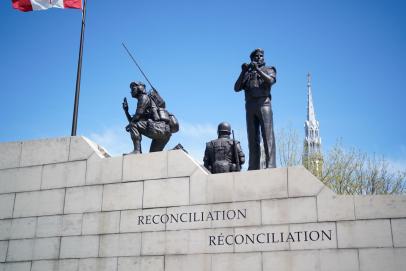
See The Simons Foundation Canada's Arctic Security Briefing Papers for information on military policies and practices in the Arctic region by Ernie Regehr O.C., Senior Fellow in Arctic Security and Defence at The Simons Foundation Canada.
Of opportunities and warning signs along the militarization highway
In a remarkably speedy departure from what had become its traditional military posture, Canada has now launched the plan to quadruple military spending. There are both opportunities, though not the dubious economic ones that are promoted through official talking points, and warning signs to be heeded along the militarization path we’ve now joined.
Having merged onto the militarization highway, Canada is now on track to take military spending from 1.3% of GDP to the target of 3.5%, plus another 1.5% on related infrastructure. So far, the prevailing national narrative labels it a highway to economic opportunity.
No matter how challenging the burgeoning national debt might become, any talk of military spending as a “burden” now has a kind of blasé, almost anti-social, ring to it. There are certainly no Churchillian calls on Canadians to endure sacrifice, to rally round, in the face of an urgent security crisis. No, Canadians are simply assured that if the Government just borrows a lot more money and cuts some civil service jobs in the name of efficiency, new fighter jets and submarines will transport us toward a prosperous new dawn.
The Prime Minister and his Government still have a chance to convert this dramatic military expansion into at least two kinds of genuine opportunity and meet urgent needs in the process. One is to finally meet the previous Government’s promise, currently ignored but not yet explicitly disavowed, to re-engage with UN-mandated peacekeeping and to contribute to similarly mandated multilateral peace support operations. The other is to match military expansion with a commensurately expanded capacity in diplomacy.
In the fourth quarter of 2025, Nanos Research conducted an extensive survey, commissioned by the University of Calgary, of Canadian attitudes towards defence and security issues.[i] On the general question, “What should be Canada’s role in the world,” respondents wrote in their preferences and it was the category of “peacekeepers/mediator/voice of reason” that topped the list. That was the priority for 30 percent of respondents, more than double the second highest choice, “a strong trade partner/economic leader/natural resource exporter,” the preference of 14%. The survey report lists the top 11 responses and they don’t include any reference to a military role. When asked directly whether Canada needs a strong military to be effective internationally, 65 percent said yes, but 66 percent also said yes to the proposition that the best way for Canada to be a world leader is through building international consensus.
Those results should tell us two things: 1) that Canadians want to see a significant part of Canada’s major increases in defence spending devoted to supporting a return to serious peacekeeping; and 2) instead of cutting its diplomatic capabilities, Canada should substantially increase them, with a specific mandate to engage in sustained peace diplomacy, mediation, and arms control – to build consensus and strengthen the voices of reason that the world desperately needs.
Peacekeeping
UN Peacekeeping is currently under-funded, under-staffed, and most certainly under-appreciated – and Canadians are telling the Government to recover its peacekeeper and peacebuilder role.
Prof. Walter Dorn, a foremost Canadian peacekeeping expert at the Canadian Forces College and Royal Military College, says it’s not too late for Canada to offer timely leadership to help revitalize peacekeeping as a vital “tool for conflict resolution and international mediation.” He points out, not only that “many current conflicts need UN peacekeepers to reach a stable and sustainable peace,” but also that with the skills of Canadian men and women in uniform, this country “could once again become a responsible and reliable leader in UN peace operations” – we just “need action-oriented politicians to make it so.[ii]
Diplomacy
An extensive, informative report by Neil Moss in Hill Times reviews planned spending cuts at Global Affairs Canada and the reactions of senior former diplomats and academics.[iii] A key point they make is that the Prime Minister has laid out an ambitious international agenda in trade and security cooperation, which former senior diplomat Roy Norton points out requires “labour-intensive” diplomacy to “follow up and move things from verbalization to actualization.”
Norton told the Hill Times that “across-the-board, quasi-uniform cuts don’t necessarily take into account what … are declared government priorities.” He warned that “the government’s setting itself up—I fear—for the inability to deliver, and for the incitement of cynicism about talk not being followed by action.”
Moss also quotes University of Ottawa professor Roland Paris, director of the Graduate School of Public and International Affairs, warning that “Mark Carney has prioritized deepening and expanding Canada’s economic and security relationships around the world, in some cases with challenging partners,” a strategy that places “a premium on effective and sustained diplomacy.” He added, that “makes the planned cuts to Canada’s foreign ministry seem both ill-timed and short-sighted.” He recognized that the Government “is making important and necessary investments in defence,” but noted that “Canada will need far more than military tools to navigate the more complex world the prime minister himself has described.”
Prime Minister Carney himself also made the case for intensified diplomacy, notably with some of the “challenging parters” Paris referred to. In the context of his meetings with President Xi in China, the Prime Minister said (in his Nov 3/25 press conference in South Korea): “we have to talk to each other if we want to make progress and address issues.”[iv]
It is the conventional wisdom that diplomacy supported by military heft will be more effective. So, if effective diplomacy needs military backing, then this is surely the time for Canada to expand, not curtail, its diplomatic presence to take advantage of the coming enhanced military power.
Building consensus is not simply a matter of speedy deal-making. Michael Ignatieff, author, educator, and the former Leader of the Liberal Party of Canada, says this of diplomats and diplomacy:
“Diplomats create frameworks, draft documents negotiate undertakings and create institutions to back up observance of agreements and make them last. Diplomacy is about creating processes, relationships and institutions that bring stability to the international system….”[v]
Opportunities for effective peacekeeping and consensus building are available in Canada’s military expansion, but warning signs are also there to be heeded.
A changing Canadian psyche?
Without overt commitments to peacekeeping, consensus building, and war prevention diplomacy, an expanded military will inevitably add to strategic tensions and expand the possibilities for contributing to the kinds of military interventions that end up making things much worse – post-Cold War examples make up a well-rehearsed list of failed military interventions, from Somalia to Afghanistan, to Iraq, Libya, and currently Palestine, Iran, and Lebanon.
The Canadian academic and prominent security analyst, Peter Jones of the University of Ottawa, has explored the implications of Canada’s turn onto a much more prominent military path that Canadians generally are not accustomed to travelling[vi]:
“…[I]t’s not clear that Canadians are used to thinking of themselves as a serious military power. It will require some significant leadership on the part of our politicians and military leaders to take the public consciousness into this space.”
In an important and informative essay, Prof. Jones suggests that our political and diplomatic class will have to get “ready to think of Canada as something other than a small, lightly armed junior ally.”
That’s a timely reminder that should also be taken as a warning that the present course is bound to alter the character of this country – and not in a good way. Canada’s political psyche is already affected, displaying a growing sense, if media headlines and commentaries are an indication, that we are a weak country, under siege, our sovereignty vulnerable, and our resilience wanting. Of course, we are indeed in a significantly changed international security environment, but explorations of responses that focus on revitalizing global multilateral institutions and diplomatic processes are drowned out in the steady stream of commentaries by pundits, politicians, and security analysts that reinforce and cultivate the climate of impending threat, and presenting the lack of sufficient military might as the cause.[vii]
The point is not to suggest that any of those individual reports or analyses are fake news. They are serious accounts that nevertheless reinforce a political mood that leaves little space for alternative perspectives or for mitigating factors. They collectively promote largely uncritical acceptance of the West’s sharp turn toward a much more militarized posture toward strategic rivals.
A climate of fear and foreboding
The current political mood is stoking the kind of fear and foreboding necessary to assure public buy-in to policies and programs that privilege public spending on all things military over support for a host of other programs that face critical funding shortages.
That sense of fear and foreboding is welcomed by some as simply facing a new reality, but it also proves useful in manufacturing consent for one of the country’s sharpest and most abrupt policy turns – based less on any independent assessment of what Canada’s most effective response to a divided world should be, than on an arbitrary, politically charged, NATO military spending formula and some, probably futile, efforts get around a mercurial American president’s punitive trade action whims.
The Canadian public had long accepted and largely appreciated that Canada consistently chose to be a relatively modest military power. It was not the laggard it was regularly caricatured to be. It still contributed to collective security as a reliable alliance member, consistently the sixth or seventh highest military spender in NATO.[viii] It remained a long and trustworthy partner in NORAD, and for some considerable time Canada was also a dedicated contributor to United Nations peacekeeping.
In the first quarter of this century, Liberal and Conservative Governments maintained that basic posture (except for their mutual retreat from peacekeeping). The failure of successive Canadian Governments was not their military spending restraint, but their declining commitment to bold action on the global stage in multilateral initiatives, development assistance, peacebuilding, peacekeeping, and arms control and war prevention diplomacy.
One prominent characteristic of a climate of fear and foreboding is that it offers no prospect of reaching a point of persuasive assurance and military sufficiency. To sustain public support for military spending at four times Canada’s traditional rate there will be no let-up in claims of heightened dangers that lurk in all that Russia and China do or fail to do – especially in or near the Arctic. Even if that 5% of GDP is reached, for many security professionals it will turn out not to be enough. We just need to look at American public discourse on security – with a $1 trillion military (set to go much higher even though it already outpaces many times over its peer adversaries combined), it still has not built confidence in the future, only bravado and an intensified narrative of threat and vulnerability.[ix]
Guns for Butter
Accompanying the profound shift in Canadian security perceptions and military spending is a key argument that recasts the “guns or butter” debate as a “guns for butter” formula with military production promoted as a route to prosperity. The burdens of high levels of military spending are now prominently spoken of as opportunity.[x] The defence industrial strategy hales the “historic opportunity to strengthen our national defence and our economy at the same time, in mutually reinforcing ways.”[xi]
Military industry is promoted as a welcome economic driver. And given the trade crisis, expectations regarding military-industrial promise is reaching new heights. Ignored are the economic studies that from the 1950s onwards consistently show the meagre job creation results of military spending compared with pretty much any other public good, from health care, to education, civilian infrastructure, and other public programs that enhance the quality of life of Canadians and reinforce a sense of national purpose and unity that in turn bolsters security.[xii]
And there is also little apparent regard for what happens when military production exhausts Canadian demand for particular equipment. We’ve been there before. When armoured vehicle production was launched in Canada in the mid-1970s to equip the Canadian Armed Forces, Canadian orders soon became intermittent or dried up, leaving many families in London, Ontario facing devastating job losses. Families that had once relied on markets for the locomotives, buses, and road graders they had been building, ended up with a stake in the highly competitive global arms trade when production switched to armoured vehicles. Initially the Pentagon became a buyer, trans-shipping some of the armoured vehicles to Saudi Arabia, but that too ran out until there were new direct orders from Saudi Arabia, with Canada’s vaunted restrictive arms export policy and its human rights principles in tatters.
Canadians can be sure that the Pentagon won’t be standing ready to pick up the slack, should Canada opt to assemble Swedish fighter aircraft, when Canadian orders again dry up. Europe is unlikely to look to Canada for fighters, given its own production facilities. A switch from US to Swedish aircraft would be a positive development for reducing reliance on the US, but the long-term implications are currently being ignored, though Project Ploughshares continues to effectively document Canada’s decades-long growth in military commodity exports to states with records of gross and systematic human rights violations.[xiii]
Peace through cooperation, consensus-building
Peace through strength has returned as a prominent watchword, while diplomacy aimed at reducing strategic tensions, resolving contentious issues and conflicts, preventing war, and advancing arms control and disarmament is set for even further sidelining through budget cuts and the current obsessive attention to military procurement and production.
In the Arctic too, militarization is sold as the path to human security. It has taken an unprecedented enthusiasm for military expansion for the Government to finally promise serious implementation of long-declared intentions to address the Arctic’s infrastructure deficits. Of course, the interests of indigenous northers go well beyond infrastructure. They have over the decades called, reiterated in a comprehensive statement in 2022, for the Arctic “to be used exclusively for peaceful and environmentally safe purposes”[xiv] and they certainly don’t want their territories to become locations for East-West strategic competition. That requires their voices to be prominently present in the conduct of international relations in the region, and also requires sustained region-wide war prevention diplomacy.
The requirement for indigenous involvement applies also to National Defence planning and implementation of upgrades to monitoring and surveillance capabilities on Canada’s northern frontiers. The same goes for intentions to be able to mount basic enforcement and defence capabilities against limited incursion. These are basic responsibilities of sovereign states, but in the Arctic the Inuit also have sovereign responsibilities in their constitutionally protected homelands, and there is a formal obligation to pursue meaningful consultation and consent for developments or initiatives that affect their homelands.
Effective defence, in the Arctic and all of Canada, rests ultimately on war prevention and the peaceful resolution of disputes. When prevention fails and the bombs start dropping, the results are mutual destruction – no winners, only tragic loss. Military forces do have a prominent role to play in war prevention, but ultimately, security and stability are best advanced by middle powers through the “peacekeepers/mediator/voice of reason” roles that Canadians, in their wisdom, say should be the priority for Canada’s role in the world.
End Notes
[i] “2025 Survey: Assessing Canadian attitudes about defence and security issues,” Section One: Canada’s Place in the World (October 19 to November 2, 2025), Nanos Research, 23 January 2026. https://nanos.co/2025-survey-assessing-canadian-attitudes-about-defence-and-security-issues-university-of-calgary-nanos/
[ii] Walter Dorn, “Broken promises: the Trudeau government let down the world on UN peacekeeping, The Hill Times, 03 March 2025. Available at https://pugwashgroup.ca/dorn-broken-promises-the-trudeau-government-let-down-the-world-on-un-peacekeeping/
[iii] Neil Moss, “Feds’ plan to slash foreign ministry budget by 20 per cent ‘ill-timed and short-sighted’: observers,” The Hill Times, 28 March 2026. https://www.hilltimes.com/2026/03/18/feds-plan-to-slash-foreign-ministry-budget-by-20-per-cent-ill-timed-and-short-sighted-observers/495776/
[iv] https://www.cpac.ca/headline-politics/episode/2025-apec-summit-pm-carney-speaks-with-reporters-in-gyeongju-south-korea?id=3ec3be1c-10ca-4515-a8ac-ff096eb7c2f0
[v] Michael Ignatieff, “It’s time to return to the art of diplomacy,” The Globe and Mail, 11 April 2026. https://www.theglobeandmail.com/opinion/article-michael-ignatieff-diplomacy-or-art-of-the-deal/
[vi] Peter Jones, “Canada’s New Submarines Will Be Lethal, Stealthy, and Very UnCanadian,” The Walrus, 10 November 2025. https://thewalrus.ca/canadas-new-submarines-will-be-lethal-stealthy-and-very-uncanadian/
[vii] For example:
Sean Boynton “Canada can no longer be ‘naive’ about the ‘real’ threats it faces: defence chief,” Global News, 16 June 2024. https://globalnews.ca/news/10567927/canada-military-defence-threats-wayne-eyre-west-block/
“‘Time is crucial now’ warns Canada’s defence chief of Arctic threats,” Radio-Canada International, 07 February 2025. https://ici.radio-canada.ca/rci/en/news/2138914/time-is-crucial-now-warns-canadas-defence-chief-of-arctic-threats
Noel Anderson, “An American military invasion of Canada? No longer unthinkable, but highly unlikely,” The Conversation, 20 March 2o25. https://theconversation.com/an-american-military-invasion-of-canada-no-longer-unthinkable-but-highly-unlikely-251959
Murray Brewster, “Thinking the 'unthinkable': NATO wants Canada and allies to gear up for a conventional war,” CBC News, 26 September 2025. https://www.cbc.ca/news/politics/nato-canada-ukraine-russia-defence-strategy-1.7333798
David Common, “As China explores the Arctic, Canada's military is preparing for confrontation,” CBC News, 28 September 2025. https://www.cbc.ca/news/canada/canada-arctic-military-exercise-sovereignty-1.7632848
Rob Huebert with Phillip Lagassé, “Canada in Dangerous Times: Strategic Outlook 2025,” Conference of Defence Associations Institute, March 2025. https://cdainstitute.ca/
[viii] “Defence Expenditure of NATO Countries (2014-2025),” See Table 2: /https://www.nato.int/content/dam/nato/webready/documents/finance/def-ex…
From 2014 through 2023, Canada consistently ranked the sixth highest in NATO member defence budgets. In 2024 and 2025 it was surpassed by Poland, making it the seventh highest – throughout it ranked in the top quartile of NATO military forces.
[ix] Matthew Smith, “Many Europeans and Americans think World War 3 is imminent,” YouGov Poll report, May 6, 2025. https://today.yougov.com/international/articles/52113-many-europeans-and-americans-think-world-war-3-is-imminent
In Pew Research Center surveys, Americans see false information, the global economy, and terrorism as the chief threats to their security (with climate change having receded as a concern). On the question of which countries are seen as posing the clearest threat, to no one’s surprise they are China (a combination of an economic and security threat) and Russia (primarily a security threat). Though the chief threats are not amenable to military solutions, it seems making a show of military might is tangible and feels real to many – but seemingly it doesn’t make them feel safer. Worries about Russia and China seem to grow in direct proportion to the growing buildup to militarily confront them.
Jacob Poushter, Moira Fagan, Maria Smerkovich, and Andrew Prozorovsky, “International Opinion on Global Threats,” Pew Research Centre, 19 August 2025 https://www.pewresearch.org/global/2025/08/19/international-opinion-on-global-threats/?_gl=1*1pwqp6g*_up*MQ..*_gs*MQ..&gclid=EAIaIQobChMI2ZGcmKPykQMV0NTCBB2bPTQ_EAAYASAAEgKGRvD_BwE&gbraid=0AAAAA-ddO9G6QdjL5KRxHkqoQbI_pgCmD
Richard Wike, Janell Fetterolf, Laura Clancy, and Jordan Lippert, “Americans’ views of allies and threats,” Pew Research Center, May 1, 2025. https://www.pewresearch.org/2025/05/01/americans-views-of-allies-and-threats/
[x] Cory Renner, Richard Forbes, “Re-building our Military Will be Expensive, but Create Opportunities,” Conference Board of Canada, 23 June 2025. https://www.conferenceboard.ca/insights/rebuilding-our-military-will-be-expensive-but-create-opportunities/
Meagen Seatter, “Carney's Bold Defense Plan: Opportunities for Canadian Investors,” Investing News Network, Aug. 26, 2025. https://investingnews.com/canada-defense-plan-opportunity/
“Canadian investors bet on defence, construction stocks as Carney targets nation-building project,” Reuters, 06 October 2025. https://www.ctvnews.ca/business/article/canadian-investors-bet-on-defence-construction-stocks-as-carney-targets-nation-building-projects/
David Perry and J. Craig Stone, “Economic Benefits of Defence Spending,” Canadian Global Affairs Institute, December 2021. https://www.cgai.ca/economic_benefits_of_defence_spending.
[xi] “Canada’s Defence Industrial Strategy,” February 2026. https://www.canada.ca/en/department-national-defence/corporate/reports-publications/industrial-strategy/security-sovereignty-prosperity.html
[xii] That there are positive economic spinoffs from military spending is not in question, but for long-run impacts, an RBC Wealth Management study concludes, “it gets trickier” (“What does greater defence spending mean for Canada’s economy?,” RBC Wealth Management, July 03, 2025. https://ca.rbcwealthmanagement.com/robert.clarke/blog/4590152-What-does-greater-defence-spending-mean-for-Canadas-economy): “Positive impacts tend to arise through industrial development, innovation, and infrastructure channels. The defence sector is notably research-intensive. Dual-use civilian/defence infrastructure can also enhance internal connectivity and access to external markets.
Negative impacts tend to stem from capital leakage, fiscal overspending, and the risk of diverting resources from more productive sectors of the economy.”
Julia Gledhill, “The Ugly Truth about the Permanent War Economy,” Stimson Center, 02 December 2024. https://www.stimson.org/2024/the-ugly-truth-about-the-permanent-war-economy/
“…[C]ivilians cannot consume weapons or produce anything with them. They are useless in the economy.”
Seymour Melman, Our Depleted Society (Holt, Rinehart and Winston, 1965), 5. - referenced by Gledhill.
Kelsey Gallagher, “Canada Strong? Analyzing Canada’s Defence Surge,” Project Ploughshares, November 19, 2025. https://ploughshares.ca/canada-strong-analyzing-canadas-defence-surge/
“Military production has been shown to be an inefficient driver of job creation because it is so capital, rather than labour, intensive. For example, a 2009 study found that for each US$1 billion spent on defence, 8,555 jobs were directly created. When the same amount is spent on more labour-intensive industries, the results go much farther: home weatherization and infrastructure (12,804 jobs), health care (12,883 jobs), education (17,687 jobs), and public transit (19,795) all produce many more jobs per public dollar spent.”
T. van Gemert, L. Lieb, and T. Treibich, “Local fiscal multipliers of different government spending categories. Empir Econ 63, 2551–2575 (2022). https://doi.org/10.1007/s00181-022-02217-5.
This is a highly technical paper, well beyond my capacity to understand. Hence, I refer only to the conclusion that fiscal multipliers of public spending are greater for non-defence spending on things like education, health, and infrastructure than on defence.
[xiii] Kelsey Gallagher, “Canada’s Soaring Arms Exports: What the 2024 Numbers Reveal,” Project Ploughshares, 29 September 2025. https://ploughshares.ca/canadas-soaring-arms-exports-what-the-2024-numbers-reveal/
[xiv] Inuit Circumpolar Council, 2022 Ilulissat Declaration, July 2022. https://www.inuitcircumpolar.com/icc-international/circumpolar-inuit-declaration-on-arctic-sovereignty/attachment/icc-2022-ilulissat-declaration-english/
Ernie Regehr, O.C. is Senior Fellow in Arctic Security and Defence at The Simons Foundation Canada; Research Fellow at the The Kindred Credit Union Centre for Peace Advancement, Conrad Grebel University College, University of Waterloo; and co-founder and former Executive Director of Project Ploughshares.